
Historical Definition
The International Association for the Study of Pain (IASP) first defined pain in 1979 as:
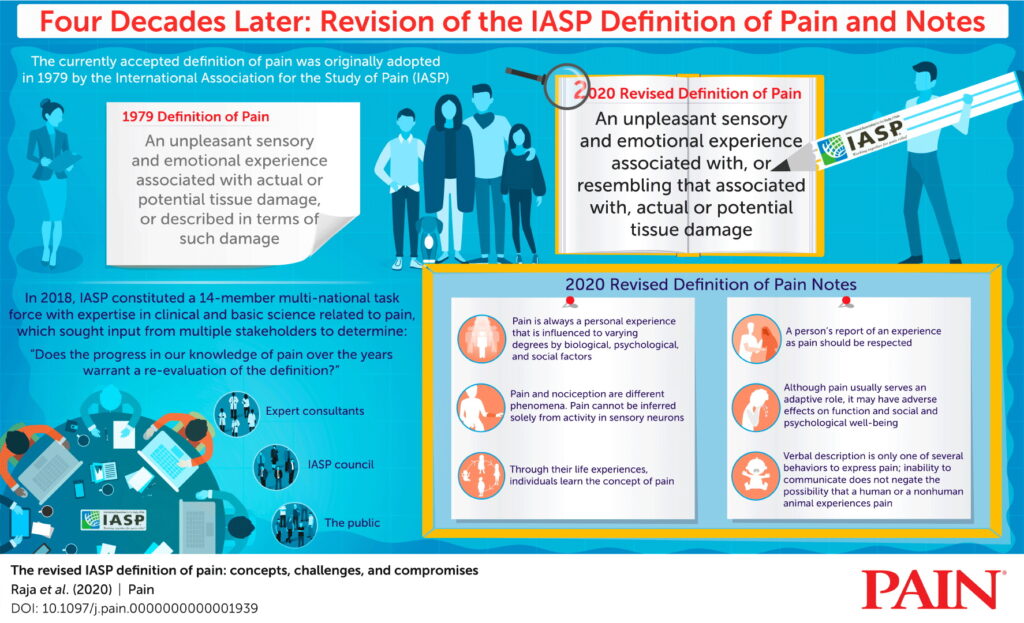
“An unpleasant sensory and emotional experience associated with actual or potential tissue damage, or described in terms of such damage.”
Even at that time, the definition recognized that pain is not merely a physical signal but has both sensory and emotional dimensions. Over the following decades, however, clinicians and researchers increasingly viewed the definition as too limited. Key critiques were that it did not fully encompass the cognitive, psychological, and social components of pain, and that it tied pain too closely to the notion of tissue damage—making it harder to describe or validate pain experiences that occur without an identifiable physical injury.
In response to these concerns, an IASP task force revised the definition between 2018 and 2020, resulting in the updated 2020 formulation now in use.
This revision is more than a change in wording: it reflects a broader recognition that pain is a complex, multidimensional experience shaped by biological, psychological, and social factors rather than a simple alarm system for bodily harm.
International Association for the Study of Pain (IASP) is widely regarded as the global standard-setting body for pain definitions.
- The current IASP definition (revised in 2020) states: “An unpleasant sensory and emotional experience associated with, or resembling that associated with, actual or potential tissue damage.”
- In other words: pain is not only a physical sensation, but also an emotional experience, and it can occur even when there is no obvious tissue damage, as long as the experience resembles what one feels when there would be damage.
- The definition emphasises that pain is subjective: only the person experiencing it can truly know its quality and intensity.
- Also, important: pain is distinct from nociception (the neural processes of sensing potential damage). Nociception may or may not lead to pain; pain always involves the personal, emotional experience.
Many other major health organisations adopt the same definition.
References
1. Raja SN, Carr DB, Cohen M, Finnerup NB, Flor H, Gibson S, Keefe FJ, Mogil JS, Ringkamp M, Sluka KA, Song XJ, Stevens B, Sullivan MD, Tutelman PR, Ushida T, Vader K. The revised International Association for the Study of Pain definition of pain: concepts, challenges, and compromises. Pain. 2020 Sep 1;161(9):1976-1982. doi: 10.1097/j.pain.0000000000001939
2. Cohen M, Quintner J, van Rysewyk S. Reconsidering the International Association for the Study of Pain definition of pain. Pain Rep. 2018 Mar 5;3(2):e634. doi: 10.1097/PR9.0000000000000634