
Pain is not a single phenomenon. Clinicians and researchers describe it along several axes: how long it lasts (acute or chronic), the mechanism that produces it (nociceptive, neuropathic or nociplastic), and the tissue or system involved. This page outlines each major type, summarises current diagnostic thinking, and explains why distinguishing between them matters for assessment and treatment. Categories overlap, and many people experience more than one type at once. Mechanistic classification describes the presumed predominant mechanism of pain rather than the disease itself.
1. Introduction
The International Association for the Study of Pain (IASP) revised its definition in 2020, describing pain as an unpleasant sensory and emotional experience associated with, or resembling that associated with, actual or potential tissue damage (Raja et al., 2020). Two features of this definition shape any classification. First, pain is an experience, not merely a signal: it cannot be equated with nociceptor activity alone. Second, it has both sensory and affective dimensions, a distinction that dates to the work of Melzack and Casey (1968) and to the gate control theory (Melzack & Wall, 1965).
Because pain arises from diverse mechanisms, no single scheme captures it. The sections below describe the three most widely used lenses: duration, mechanism and location.
2. Classification by duration
2.1 Acute pain
Acute pain commonly occurs in association with tissue injury, inflammation or surgery and usually has an adaptive, protective role. It typically diminishes as the underlying condition resolves, although pain intensity does not necessarily correspond directly to the extent of tissue damage. Postoperative pain, fractures and dental pain are common examples.
2.2 Chronic pain
Chronic pain is defined as pain that persists or recurs for longer than three months. Although this often extends beyond the expected period of tissue healing, persistence beyond healing is not required for the definition. In the eleventh revision of the International Classification of Diseases (ICD-11), the IASP distinguishes chronic primary pain, where pain is regarded as a condition in its own right (for example, fibromyalgia or chronic primary low back pain), from chronic secondary pain, where pain is a symptom of another disease (for example, cancer-related, post-surgical or osteoarthritic pain) (Treede et al., 2019). Chronic pain is associated with substantial disability, distress and health-care use worldwide (Cohen et al., 2021).
3. Classification by anatomical origin or distribution
Pain may also be described according to its anatomical origin or distribution, for example musculoskeletal, visceral, craniofacial, pelvic or widespread pain. Such descriptors identify where pain is experienced or from which tissue or system it is thought to arise, but they do not define the underlying pain mechanism. A single anatomical condition may involve nociceptive, neuropathic and nociplastic mechanisms.
4. Classification by mechanism
4.1 Nociceptive pain
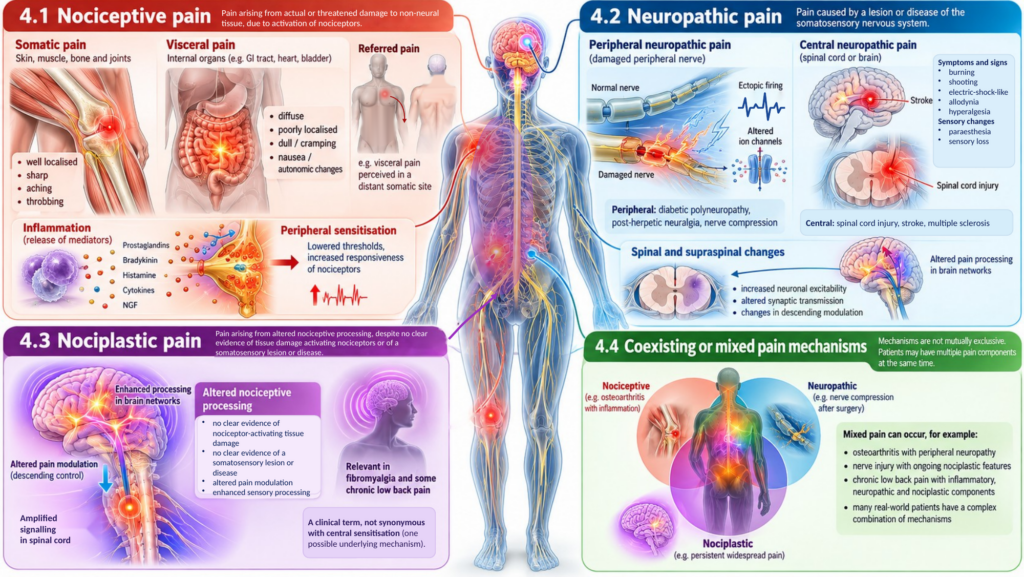
Nociceptive pain arises from activation of nociceptors by actual or threatened damage to non-neural tissue. It is usually subdivided as follows.
Somatic pain originates in skin, muscle, bone and joints. It is typically well localised and described as sharp, aching or throbbing. Visceral pain originates in internal organs. It tends to be diffuse, poorly localised and dull or cramping, and is often accompanied by nausea or autonomic changes. Because visceral and somatic afferents converge on shared spinal neurons, visceral pain is often felt at a distant site, a phenomenon known as referred pain. Inflammation can enhance nociceptive pain through peripheral sensitisation: inflammatory mediators lower nociceptor thresholds and increase responsiveness to mechanical, thermal and chemical stimuli. (Woolf, 2010).
4.2 Neuropathic pain
Neuropathic pain is defined as pain caused by a lesion or disease of the somatosensory nervous system (Jensen et al., 2011). Peripheral causes include diabetic polyneuropathy, post-herpetic neuralgia and nerve compression; central causes include spinal cord injury and stroke. Common features include burning, shooting or electric-shock-like pain, paresthesia, allodynia, hyperalgesia and sensory loss. These symptoms are suggestive but are not themselves diagnostic. Clinical assessment should establish a plausible lesion or disease affecting the somatosensory nervous system and determine whether the pain distribution is neuroanatomically consistent with that lesion. Underlying mechanisms include ectopic nerve firing, altered ion-channel expression and changes in spinal and supraspinal processing (Finnerup et al., 2021).
4.3 Nociplastic pain
Nociplastic pain was proposed as a third mechanistic descriptor for pain that arises from altered nociceptive processing, despite no clear evidence of tissue damage activating nociceptors and no evidence of a somatosensory lesion or disease (Kosek et al., 2016, Kosek et al., 2021). Nociplastic pain is thought to involve altered nociceptive processing, which may include peripheral and/or central sensitisation, altered pain modulation and enhanced sensory processing. However, nociplastic pain should not be considered synonymous with central sensitisation, and its underlying mechanisms remain incompletely understood. Nociplastic mechanisms are considered particularly relevant in conditions such as fibromyalgia and may contribute to some presentations of chronic low back pain and other chronic widespread or regional pain conditions. Individual patients should nevertheless be phenotyped rather than assigning a mechanism solely on the basis of the diagnostic label (Fitzcharles et al., 2021).
4.4 Coexisting or mixed pain mechanisms
Pain mechanisms are not mutually exclusive. A patient may simultaneously have nociceptive, neuropathic and/or nociplastic components. The term “mixed pain” is commonly used clinically to describe such presentations, although it is not a separate mechanistic category equivalent to nociceptive, neuropathic or nociplastic pain.
5. Summary of types
Table Principal types of pain and their characteristics
| Type | Predominant mechanism | Typical descriptors | Examples |
| Acute | Recent injury or inflammation | Sharp, proportionate, time-limited | Fracture, surgery |
| Chronic | Pain persisting or recurring for >3 months | Variable; often with distress and disability | Chronic low back pain |
| Nociceptive (somatic) | Nociceptor activation in body tissue | Localised, aching, throbbing | Sprain, arthritis |
| Nociceptive (visceral) | Nociceptor activation in organs | Diffuse, cramping, referred | Kidney stone, colic |
| Neuropathic | Lesion or disease of the somatosensory nervous system | Burning, shooting, allodynia | Diabetic neuropathy, PSPS |
| Nociplastic | Altered nociception not adequately explained by nociceptive or neuropathic mechanisms | Widespread, with fatigue and sleep disturbance | Fibromyalgia |
Note. Categories are not mutually exclusive. A single condition may be acute or chronic and involve one or several mechanisms.
6. Implications for assessment and management
Identifying the dominant pain type guides investigation and treatment. Mechanistic classification can help inform treatment but does not determine therapy by itself. Nociceptive pain may respond to treatment of the underlying tissue disorder and appropriate analgesic strategies. For neuropathic pain, evidence-based pharmacological options commonly include certain antidepressants and gabapentinoids, alongside condition-specific interventions (Finnerup et al., 2021). Chronic primary and predominantly nociplastic presentations are generally managed using a multimodal approach incorporating education, physical activity, rehabilitation and psychological or behavioural strategies where appropriate (Cohen et al., 2021).
7. Conclusion
Pain can be classified by duration, mechanism and location, and each lens answers a different question: how long, by what process, and where. The mechanistic triad of nociceptive, neuropathic and nociplastic pain, alongside the acute and chronic distinction, provides a practical framework, but it is a simplification of overlapping and often coexisting processes. Ongoing research continues to refine these categories.
References
Cohen, S. P., Vase, L., & Hooten, W. M. (2021). Chronic pain: an update on burden, best practices, and new advances. The Lancet, 397(10289), 2082–2097.
Finnerup, N. B., Kuner, R., & Jensen, T. S. (2021). Neuropathic pain: from mechanisms to treatment. Physiological Reviews, 101(1), 259–301.
Fitzcharles, M.-A., Cohen, S. P., Clauw, D. J., Littlejohn, G., Usui, C., & Häuser, W. (2021). Nociplastic pain: towards an understanding of prevalent pain conditions. The Lancet, 397(10289), 2098–2110.
Jensen, T. S., Baron, R., Haanpää, M., Kalso, E., Loeser, J. D., Rice, A. S. C., & Treede, R.-D. (2011). A new definition of neuropathic pain. Pain, 152(10), 2204–2205.
Kosek, E., Cohen, M., Baron, R., et al. (2016). Do we need a third mechanistic descriptor for chronic pain states? Pain, 157(7), 1382–1386.
Kosek E, Clauw D, Nijs J, Baron R, Gilron I, Harris RE, Mico JA, Rice ASC, Sterling M. Chronic nociplastic pain affecting the musculoskeletal system: clinical criteria and grading system. Pain. 2021 Nov 1;162(11):2629-2634
Melzack, R., & Casey, K. L. (1968). Sensory, motivational, and central control determinants of pain. In D. R. Kenshalo (Ed.), The Skin Senses (pp. 423–443). Charles C. Thomas.
Melzack, R., & Wall, P. D. (1965). Pain mechanisms: a new theory. Science, 150(3699), 971–979.
Raja, S. N., Carr, D. B., Cohen, M., et al. (2020). The revised International Association for the Study of Pain definition of pain: concepts, challenges, and compromises. Pain, 161(9), 1976–1982.
Treede, R.-D., Rief, W., Barke, A., et al. (2019). Chronic pain as a symptom or a disease: the IASP Classification of Chronic Pain for the International Classification of Diseases (ICD-11). Pain, 160(1), 19–27.
Woolf, C. J. (2010). What is this thing called pain? The Journal of Clinical Investigation, 120(11), 3742–3744.
This page is for educational purposes and is not a substitute for medical advice.